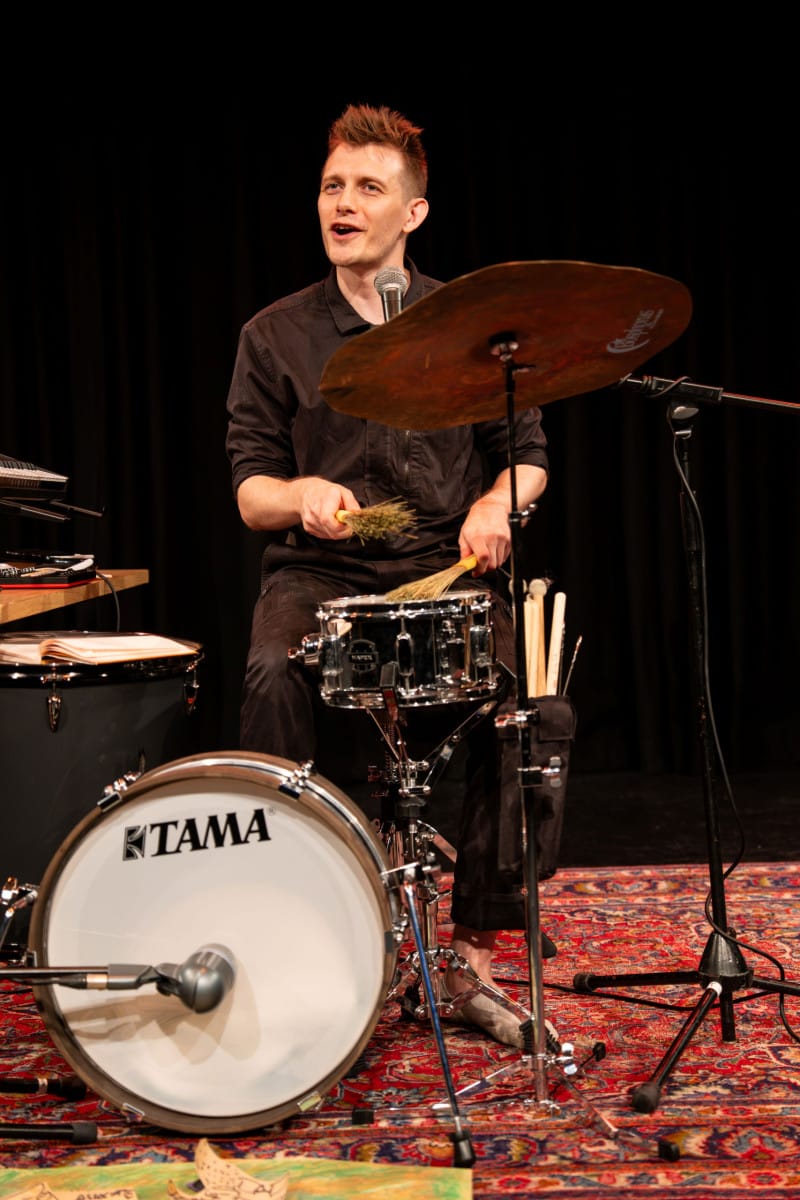
Offering the time and space to try things out and play with ideas, the Sanctuary artist development residency at Lighthouse Poole is highly prized by participants.
“Having the opportunity at Lighthouse to experiment and study this work, it’s sort of a boundaryless moment where I can really sink into the work,” says cross disciplinary artist Antosh Wojcik who is developing Suburban Locust, a live show with drums and sound design based on his book of poetry of the same name published last year by Bad Betty Press.
“I’m a poet who performs work regularly, reading it, but I also have the drums as another artistic language. So, I’m working on this idea of what a live presentation of the material might be in a longer form, maybe like an hour-long show.
“If this time and space wasn’t here, I probably wouldn’t be developing Suburban Locust at this point, so I think Sanctuary has given me the impetus to really do this now and I’m incredibly grateful for that.”
Suburban Locust explores what happens to a family that comes apart after a disagreement between two members we might recognise as the father and daughter. The eldest son becomes a middle person, a go-between to mediate between those in opposition.
“What happens is when their family gets blown apart, this swarm of locusts comes out as a sort of metaphor of all the things that have been unsaid, or not sorted out, or are unknown to those of us in the family.”
It’s at least partially autobiographical then?
“I put it together very conceptually, thinking of it almost like a concept album. The material is rooted in my autobiography and is a kind of study of the nuclear family in Britain, but we’re also from a migrant refugee experience – on my dad’s side, we’re Polish, and it’s only through writing this book that I’ve kind of realised and accepted and grappled with being from someone who was a refugee.”
The complexities of family relationships will be familiar to many people, regardless of their heritage, and Antosh is framing Suburban Locust in those terms, albeit with a twist.
“Well, it’s an implosion between my sister and my dad, essentially. And I’m in the middle as a mediating force of sorts. So, it tackles a lot to do with being a brother and working out how you let someone go to see if they can find what they need to then, possibly, be an open gateway back into the family.
“I feel like I’m exploring the father quite a lot and because he is the patriarchal figure, it’s like learning what part of that I have and what part of that do I want to refuse, to renounce; what of it is problematic. There’s lots of underlying difficulties of masculinity in the book as well and I’m trying to navigate that but also be honest about it; all sorts of internalised violence in me that I didn’t realise was there, which is why drumming is a really helpful device because it is such a physical act.
“The drums give me a language to be able to say stuff that feels very vulnerable but gives me like a buoyancy or a kind of catharsis.”
Being focussed on creating a performance during his Sanctuary residency has not only given Antosh the freedom to experiment, but the focus to push his ideas further.
“I’m playing with this idea of a show that is slightly different every time it’s performed, seeing whether or not I can improvise portions of it and if something different can come out each time. I’m working out whether we always start in the same place and end in the same place, with the journey in the middle slightly random or found.
“I want to work with an audience to find the show with them because the poems are truthful, but they’re also very surreal and strange. So, I want to see how I can bring people into that soupy exploration.”
It’s an exploration that, ultimately, has taught Antosh as much about where he’s from as where he’s at.
“I think assimilation is core to this; it’s almost a foundational thing to explore because we have this discourse around heritage and I’m throwing myself into the Polish side, but through doing that that I’ve actually felt my dual heritage. I am English and there’s very English, British stuff going on in here as well.
“In an arts space I’m encouraged to embrace my heritage, but through this process of writing the book and performing the work, I’ve seen that to some people, heritage is just not important – my brother for instance is almost at a point of even possibly changing his last name, anglicising it, because he really doesn’t identify.
“I’m like: ‘Oh, don’t do it.’ But at the same time, that is kind of his right as well. We’re at a point where, in terms of identity, we’ve really tried to be super liberal, and I think that does mean also being okay with the fact that some people want to strip away parts of themselves – it has to be that fluid.”
(NC)